Grape
Vitis spp.
You remove around ninety percent of last year's growth every winter. Nervous pruning gives poor grapes.
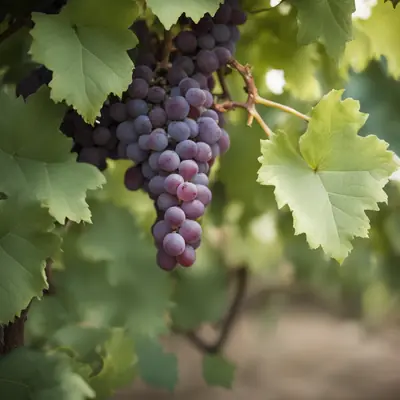
Choose for this climate
American varieties (Concord, Niagara, Catawba) and French-American hybrids (Seyval, Vidal, Chambourcin, Marquette) handle our humidity, cold and disease pressure far better than European vinifera wine grapes, which struggle badly here without an intensive spray programme. Muscadines suit the warmer southern end of the region.
Build a permanent trellis first
A grape vine is a thirty-year commitment to a fixed structure. Set stout end posts and two wires, at about three feet and six feet, before planting. Retrofitting support to an established vine is miserable work.
Establish a trunk and cordons
In the first two years, ignore fruit entirely and build structure: select one strong shoot as the trunk, tie it up, and once it reaches the top wire select two shoots to run each way as permanent cordons. Everything afterwards is renewal of the fruiting wood on those cordons.
Prune hard - this is the crux
Grapes fruit on shoots that grow from one-year-old wood. Each late winter, remove roughly 90% of the previous season's growth, leaving either short spurs of two or three buds along the cordons (spur pruning) or a few long canes with the rest removed (cane pruning). Leaving too many buds gives a tangle of foliage, poor air circulation, and many small sour bunches. Under-pruning is by far the commonest home-garden grape mistake.
Summer management
Remove leaves around the developing clusters in midsummer to expose them to sun and air, which improves ripening and reduces rot. Thin excess clusters on young or overloaded vines. Keep the fruiting zone open.
Diseases
Black rot is the major one here - small brown fruit lesions that shrivel into hard black mummies, which then infect the following year. Remove every mummy from the vine and the ground. Downy and powdery mildew, phomopsis and botrytis all occur in humid summers. Airflow through hard pruning and leaf removal is the most effective non-chemical control, alongside resistant varieties.
Pests
Japanese beetles skeletonise leaves in midsummer and can be severe. Grape berry moth webs and tunnels into berries. Birds and wasps take ripening fruit - bagging individual clusters in paper or fine mesh bags is laborious but very effective and also excludes berry moth.
Harvest
Grapes do not sweeten at all after picking, so taste before harvesting rather than going by colour, which changes weeks early. Ripe bunches taste sweet, the seeds have turned brown, and the stems begin to lignify. Cut whole clusters with secateurs.
Storage
A few weeks refrigerated for table grapes. Concord-type grapes make excellent juice and jelly; hybrids make respectable wine. Freezing whole grapes works well for juicing later.
- Hardiness
- Zone 4-9 by type
- First fruit
- Year 3
- Spacing
- 6-8 ft
- Sun
- Full
- pH
- 5.5-7.0
- Prune
- Hard, late winter
- Support
- Permanent trellis
- Life
- 30+ yrs