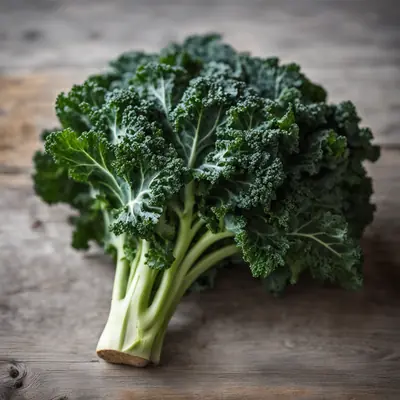
Kale
Brassica oleracea var. sabellica
The crop that is still standing in January when everything else has given up.
Grow it for autumn and winter
Kale is merely acceptable in summer and genuinely good after frost. Sow or transplant in midsummer for a crop that comes into its own in October and can carry through to the following spring. Spring sowings work but the leaves are coarser and the aphids worse.
Direct sow or transplant
Either works. Direct sowing in midsummer needs consistent moisture to germinate in warm soil; transplants give more control. Space at twelve to eighteen inches - crowded kale makes small leaves and holds moisture in the canopy.
Harvest from the bottom up
Take the lowest mature leaves, snapping them cleanly at the stem, and always leave the growing point plus six to eight young leaves. Managed this way one plant produces for months and ends up on a tall bare stalk like a small palm.
Frost is the point
Freezing triggers conversion of starch to sugar as antifreeze. The difference is dramatic - the same leaf is markedly sweeter and less bitter after a couple of hard frosts. Plan the crop around this rather than treating it as a bonus.
Winter protection
Kale survives to around 10F unprotected. A low tunnel, row cover or a thick straw mulch around the base extends useful harvest well into a zone 6b/7 winter and can carry plants to spring, when they bolt and produce edible flower shoots.
Aphids are the main problem
Grey cabbage aphids colonise crowns and leaf undersides in late autumn and are very hard to wash out of curly types once established. Check weekly from September, knock them off with a strong jet of water, and use insecticidal soap underneath the leaves if needed. Lacinato types are far easier to clean.
Other pests
Cabbageworm and looper chew through summer - row cover or Bt. Flea beetles pepper young plants in spring. Harlequin bugs can be serious in late summer and are best hand-picked into soapy water.
Kitchen and storage
Keeps about a week in the fridge. Strip the tough midrib for quick cooking and leave it in for a long braise. Raw kale improves greatly if you massage the cut leaves with a little oil and salt to break down the cell walls. It freezes well blanched.
- Days to harvest
- 50-65
- Spacing
- 12-18 in
- Row spacing
- 18-24 in
- Sun
- Full to part
- pH
- 6.0-7.5
- Hardy to
- ~10F
- Best season
- Fall and winter
- Harvest
- Continuous